
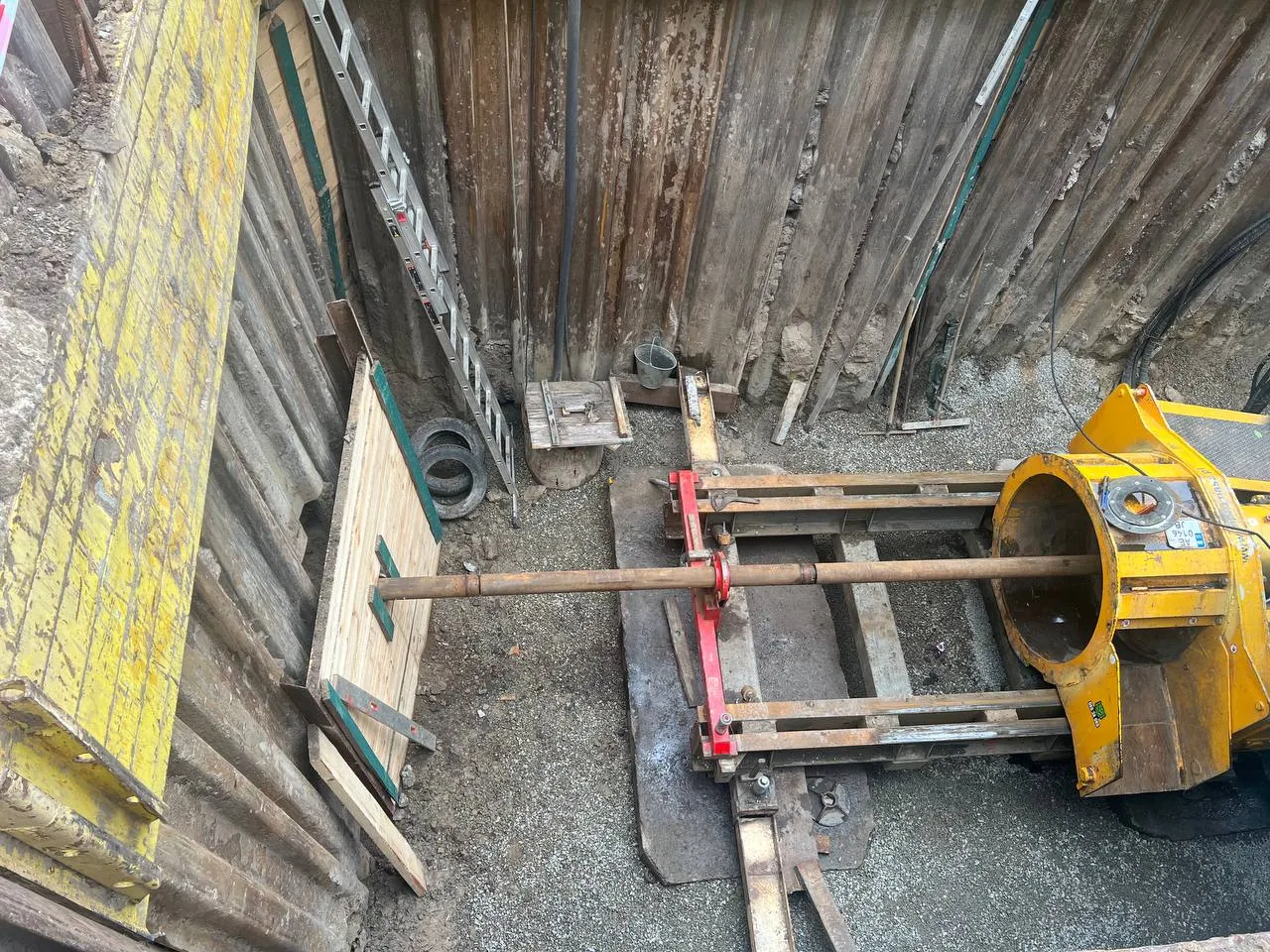
Guided auger boring
Trenchless installation of DN 600–1400 pipelines and steel casings using a guided pilot bore, auger excavation and sequential jacking of pipe sections.
How the work is carried out
A simplified scheme of the key stages. Scroll to see the sequence.
Typical applications
- Crossings under roads and railways
- Large-diameter trenchless pipeline installation
- Gravity sewer construction with controlled grade
- Steel protective casings for utility networks
- Industrial sites and dense urban areas
- Projects requiring a straight, accurately controlled alignment
Things to consider
- Launch and reception pits are required
- Pit design and shoring are selected according to depth, geology and external loads
- Maximum drive length depends on diameter, soils, rig capacity and tooling
- Boulder-bearing, rocky and water-saturated soils require a project-specific solution
- The exact method, pipe type and tooling are selected after a site survey
Technical capabilities
Work stages
- 01
Survey and input data
Route analysis, geology, depth, diameter, obstacles and existing utilities.
- 02
Engineering calculation
Rig, pipe, casing, tooling, section length and pit design selection.
- 03
Pit preparation
Launch and reception pit construction and shoring, guide frame installation.
- 04
Boring and pipe jacking
Pilot bore, reaming, sequential pipe jacking and auger spoil removal.
- 05
Verification and handover
Pipeline position check, as-built documentation and handover.
What the customer gets
- Acceptance act
- As-built documentation
- Confirmation of the installed pipeline position
- Project-required test results
- Warranty obligations
FAQ
How does guided auger boring differ from HDD?
In HDD the finished pipe is typically pulled back through a reamed bore. In guided auger boring, pipe or casing sections are jacked forward from the launch pit while augers remove the spoil back through the pipe string.
What diameters can be installed?
The stated working range is DN 600 to DN 1400. Final method selection depends on drive length, pipe material and ground conditions.
Can a precise gravity sewer grade be achieved?
Yes, the pilot system allows line and grade to be monitored and controlled. Permitted tolerances are set by the design and specific rig configuration.
Are pits always required?
Yes. The rig operates from the launch pit; the pilot tooling is received and the drive completed in the reception pit.